Recipe Management in the Food Industry: From Spreadsheets to Software
Recipes are the foundation of every food business. They determine what goes into your product, what appears on the label, what it costs, and whether it complies with the law. Yet many manufacturers still manage their recipes in Excel, in a folder on a shared drive, or in an ERP system that was never built for the food industry.
That works. Until it doesn't. Until a supplier changes a raw material and you have to manually check twenty products. Until a customer asks for a current specification and you spend three hours tracking down the right version. Until the Food Standards Agency comes knocking and your audit trail is a collection of spreadsheets with unclear file names.
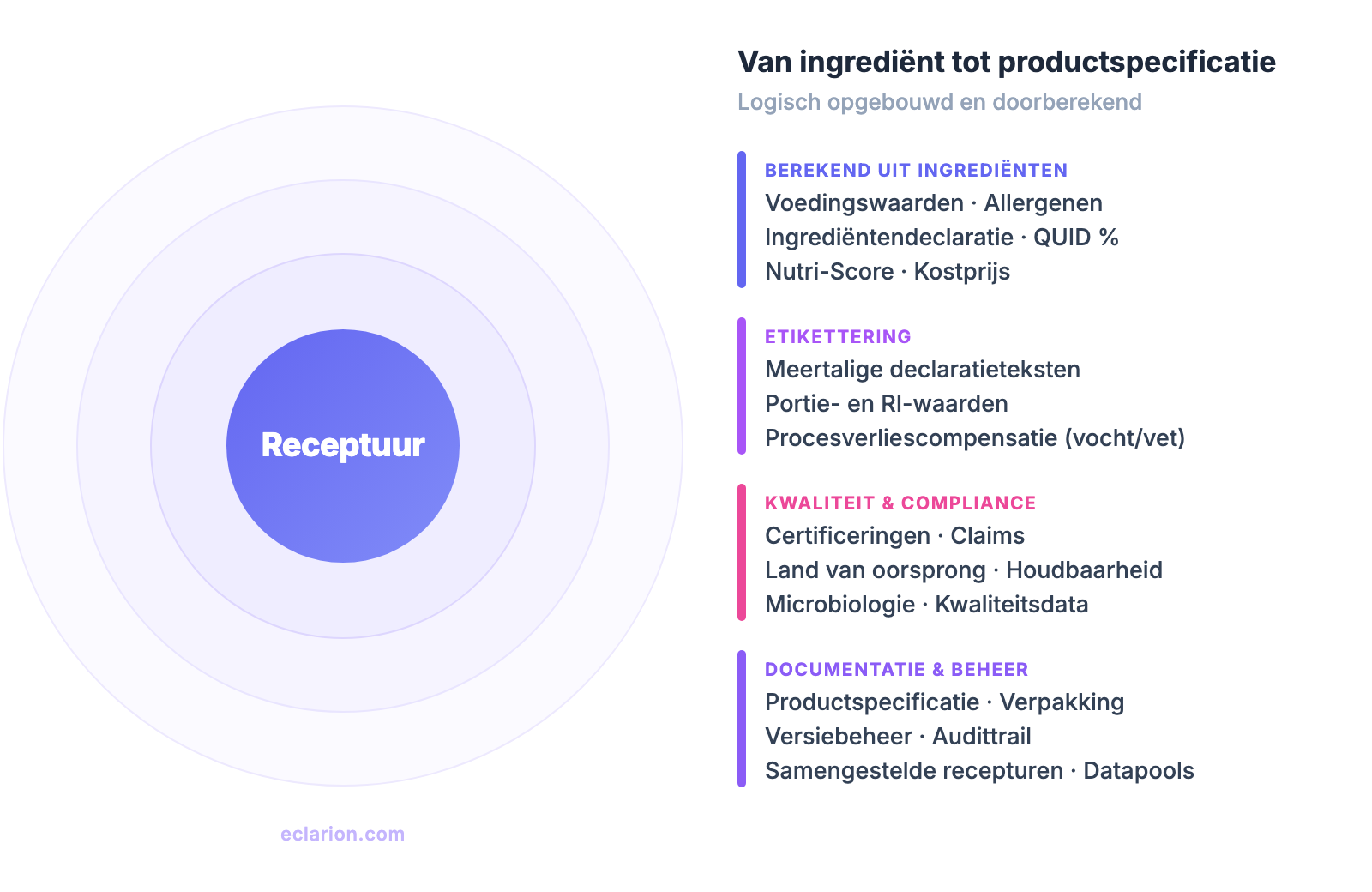
Recipe management is more than a list of ingredients with percentages. It is the engine behind your nutritional values, your ingredient declaration, your allergen profile, and your cost calculation.
What is recipe management?
Recipe management is the structured recording, managing, and updating of your product compositions. In the food industry, this goes beyond simply noting ingredients and quantities. A complete recipe management system covers:
- Ingredients with weights and percentages: the basis of every recipe
- Compound recipes: semi-finished products and sub-recipes used as ingredients in finished products
- Automatic nutritional value calculation: based on the composition, including processing losses
- Allergen management: derived allergen information per product based on the raw materials used
- Ingredient declaration: automatically generated ingredient list in the legally required order
- Cost calculation: ingredient costs per batch and per unit
- Version control: complete history of changes with the ability to revert to previous versions
- Preparation instructions: methods, temperatures, times, and processing steps
Why is recipe management important?
Everything is connected to the recipe
The recipe is the starting point for virtually all product information. Change one ingredient and the consequences affect multiple areas:
- The nutrition declaration changes
- The ingredient declaration needs updating (order may change)
- The allergen profile can change (new allergens, removed allergens)
- The cost price changes
- The product specification needs updating
- The label needs to be regenerated
With manual recipe management, you have to update each of these elements separately. Miss one, and you have an inconsistency that surfaces during an audit or inspection.
Legal requirement
EU Regulation 1169/2011 requires that the information on the label matches the actual composition of the product. In practice, this is the most common cause of labelling errors: the recipe has changed, but the label has not. Good recipe management prevents this by deriving label information directly from the current recipe.
Cost control
Raw material prices fluctuate. With insight into the cost structure per recipe, you can quickly calculate what a price change for a raw material means for your finished product. Without centralised recipe management, this is manual work that has to be repeated with every price change.
How most companies do it today (and why it goes wrong)
Excel and spreadsheets
The most widely used "tool" for recipe management is still Excel. Understandable: it is available, flexible, and everyone knows it. But for recipe management, Excel has fundamental limitations:
- No relationships between recipes: if a semi-finished product is used in five finished products and you change that semi-finished product, you have to manually update five spreadsheets
- No automatic calculations: nutritional values, allergen profiles, and ingredient declarations have to be calculated manually or with error-prone formulas
- No version control: which version is current? Who changed what and when? In Excel, that is guesswork
- No access control: anyone can change anything, there is no approval workflow
- Does not scale: with ten products it is manageable. With a hundred products it becomes unmanageable
ERP modules
Many ERP vendors offer a recipe module. On paper, that sounds logical: everything in one system. In practice, these modules are typically not built for the specific requirements of food manufacturers:
- Generic data structure: free text fields instead of structured food data
- No nutritional value calculation: the calculation of nutritional values based on the recipe is missing
- No allergen management: systematic derivation of allergens from raw materials is not built in
- No ingredient declaration: automatic generation of a legally compliant ingredient list is missing
- Implementation time: expect years of customisation, an external consultancy firm, and a substantial budget
The result: you have a recipe module that captures the basic structure, but for everything that truly matters (nutritional values, allergens, labelling) you fall back on Excel or manual processes.
Paper recipe cards
Yes, this still exists. Especially in smaller bakeries and artisan producers, recipes are kept on paper or in a notebook. Works fine for five products. Until you start growing.
The three options compared
| Excel / Word | ERP module | Specialised tool | |
|---|---|---|---|
| Compound recipes | Manual copying | Limited | Hierarchical, automatic recalculation |
| Nutritional value calculation | Manual or formulas | None or limited | Automatic incl. processing losses |
| Allergen management | Manual tracking | Free text fields | Automatically derived from raw materials |
| Ingredient declaration | Manual assembly | Manual | Automatic per EU 1169/2011 |
| Version control | File names | Basic | Full with audit trail |
| Cost calculation | Separate spreadsheet | Yes, but separate from recipe | Integrated in recipe |
| Implementation time | Immediate | Years | Days |
Recipe management software in practice
Compound recipes
A supplier changes a raw material. That raw material is in a semi-finished product. That semi-finished product is in twelve finished products. You update the raw material once. The twelve products recalculate: nutritional values, allergens, declarations, cost price.
Automatic nutritional value calculation
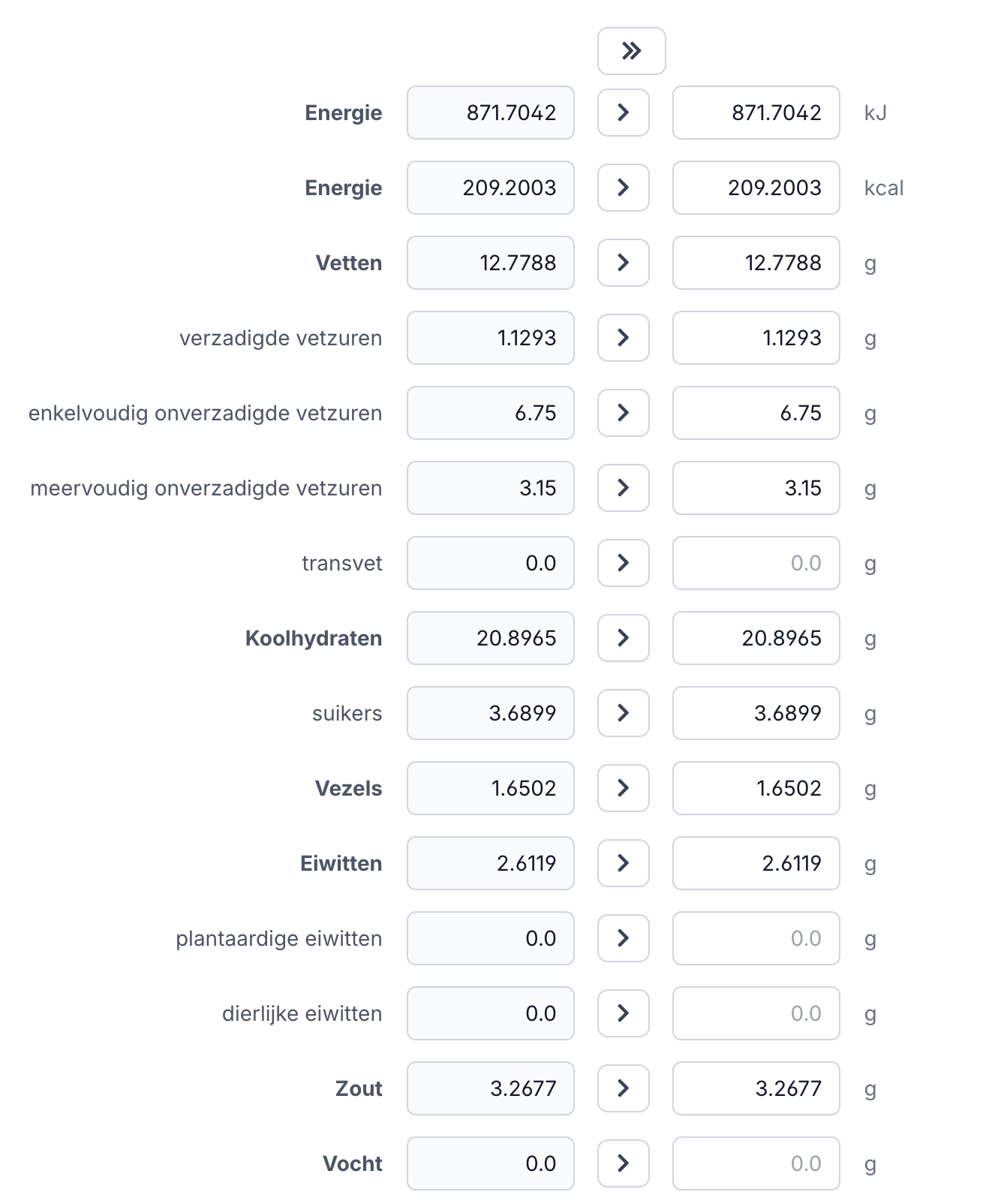
Nutritional values are calculated from the recipe, including processing losses. You enter the weight before and after processing, and the rest follows automatically.
Allergen management from the recipe
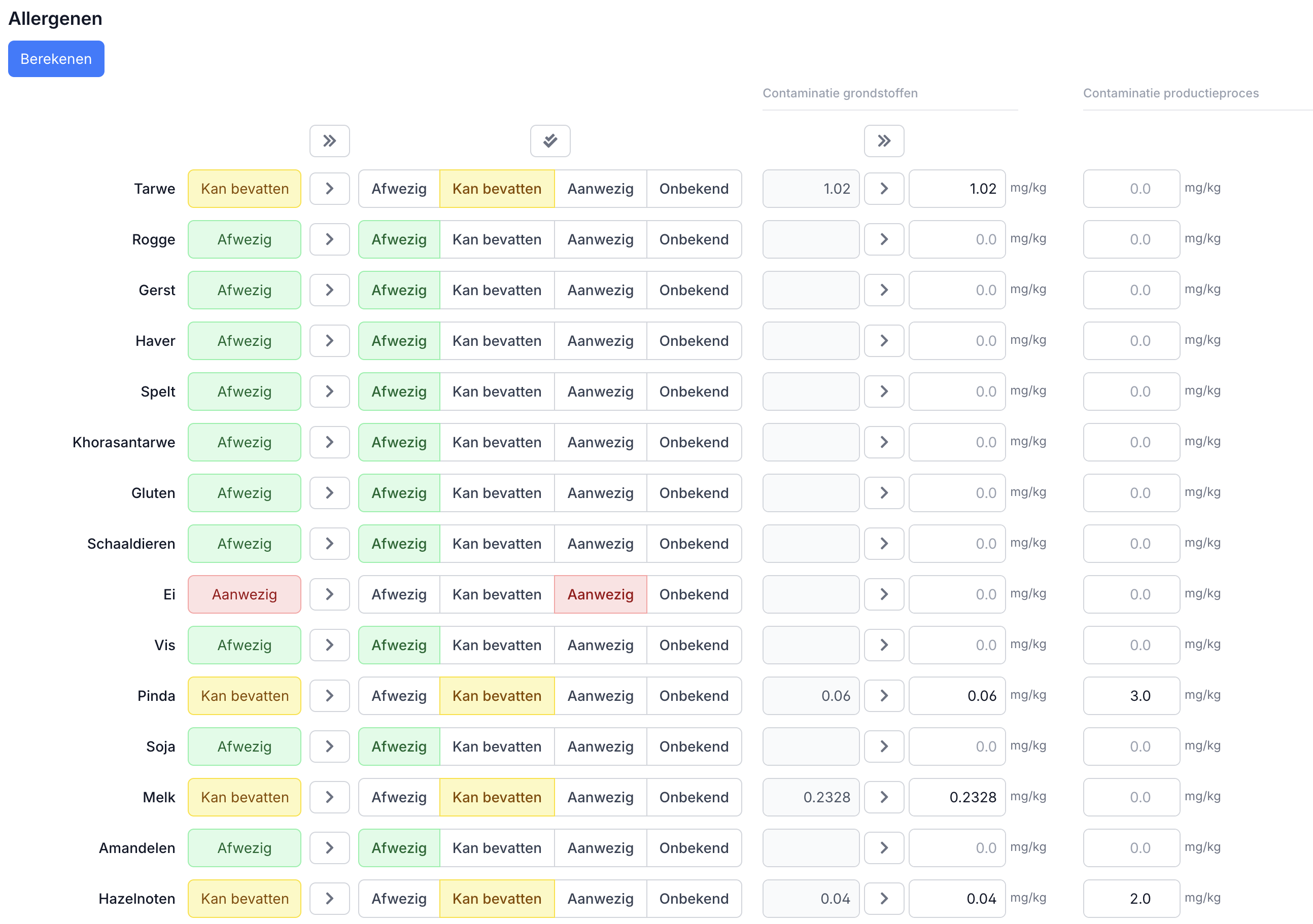
Per raw material, you record the allergen status: contains, may contain, absent. Especially the "may contain" status is becoming increasingly important with the new PAL guidelines. Eclarion automatically calculates whether precautionary allergen labelling is needed via the PAL assessment. The allergen profile of your finished product follows automatically from the raw materials. Change one, and you immediately see which products are affected.
Generating the ingredient declaration
The ingredient declaration is generated directly from the recipe: descending order, compound ingredients broken down, allergens highlighted, QUID percentages where required. Compliant with EU 1169/2011, without manual work.
Version control and audit trail
An auditor asks: "What was the composition of this product on 14 March last year?" With a spreadsheet, you have a problem. With version control, you have the answer in two clicks. Every change is recorded (who, what, when) and previous versions are directly accessible. This is also a requirement under HACCP principle 7 and certifications such as FSSC 22000 and BRCGS.
Cost calculation
By linking ingredient prices to raw materials, you calculate the raw material costs per batch and per unit. When raw material prices fluctuate, you immediately see the effect on your cost price. No more separate cost calculation that is disconnected from your recipe.
Recipe management and production sheets
The recipe is not only the basis for labelling and specifications, but also for the production floor. A production sheet translates the recipe into practical instructions: quantities scaled to batch size, preparation sequence, temperatures, and process times.
With flexible templates, you generate a production sheet per product that is directly usable for your production staff. One source, multiple outputs: product specification for customers, production sheet for the shop floor, label information for the packaging line. All from the same recipe.
The step to professional recipe management
The switch from Excel to dedicated software does not have to be a big project. In fact: if it becomes a big project, you are probably choosing the wrong tool.
With Eclarion you import your existing recipes, add raw materials with their nutritional values and allergen information, and you are operational. No implementation consultant spending three months mapping your processes. No customisation project that costs more than the software itself. Just log in, enter recipes, and immediately benefit from automatic calculations, allergen management, and version control.
That is the fundamental difference from an ERP module or a large PLM system: you do not have to reorganise your entire organisation first to manage your recipes professionally. You simply start.
Frequently asked questions about recipe management
What is the difference between recipe management and specification management?
Recipe management focuses on the composition of the product: which ingredients, in which quantities, with which preparation method. Specification management covers the broader product dossier: alongside the recipe, also packaging information, storage conditions, certifications, and microbiological specifications. In practice, they are inseparable: the specification is only complete when the recipe is correct.
Can I import my existing Excel recipes?
Yes, most professional recipe management systems support importing existing data. The time investment is not in the import itself, but in validating the data: are the nutritional values of your raw materials correct? Is the allergen information complete? This clean-up is a one-time effort and immediately delivers a more reliable foundation.
How does recipe management work for products with seasonal variations?
By recording the base recipe and managing a separate version per season or variant. In a system with version control, you can have variants side by side, each with their own calculated nutritional values and ingredient declaration.
What if I work with multiple production sites?
The recipe is leading, regardless of the production site. With centralised recipe management in a cloud system, every site works with the same current recipes. Production sheets can be generated per site with site-specific batch sizes.
How does recipe management relate to PLM?
PLM (Product Lifecycle Management) covers the full lifecycle of a product. Recipe management is a part of it, just like specification management, project management, and portfolio management. For many manufacturers, recipe and specification management is the core. You do not necessarily need to implement a full PLM system to manage your recipes professionally.
Is a dedicated tool necessary or is my ERP sufficient?
That depends on what your ERP offers. If your ERP automatically calculates nutritional values from recipes, derives allergens from raw materials, generates ingredient declarations, and maintains a complete audit trail, then you may have enough. In practice, most ERP systems do not offer this. A dedicated tool that seamlessly connects with your ERP for article data and pricing gives you the best of both worlds.
Every product starts with the recipe
Recipe management is not an administrative afterthought. It is the foundation of your labelling, your specifications, your cost calculation, and your compliance. Every error in the recipe cascades into everything that follows.
The choice is simple: keep manually calculating in Excel and hoping you do not miss anything after a change? Invest years in an ERP module that only does half of what you need? Or choose a tool that is specifically built for food manufacturers and that you can use tomorrow?
With Eclarion you manage recipes with automatic nutritional value calculation, allergen management, cost calculation, and a complete audit trail. Start with a free trial and enter your first recipe.