Product Specifications: Management, Compliance and Software
A product specification contains everything you need to know about a food product: ingredients, allergens, nutritional values, shelf life, packaging information and more. It is the foundation for your labelling, quality control and compliance. Yet a surprising number of food manufacturers still manage their specifications in Excel, loose Word files or as attachments in an ERP system that was never really built for it.
There is a smarter way. Below you will find what product specifications contain, why proper specification management makes the difference, and how to set it up without expensive consultancy projects.
What Is a Product Specification?
A product specification is the central document describing all properties of a food product. It is the "single source of truth" for everyone involved with the product: quality managers, production, procurement, sales and external buyers.
A complete product specification in the food industry typically includes:
- Ingredients and composition: full recipe with percentages, ingredient declaration in accordance with EU Regulation 1169/2011 and origin of raw materials
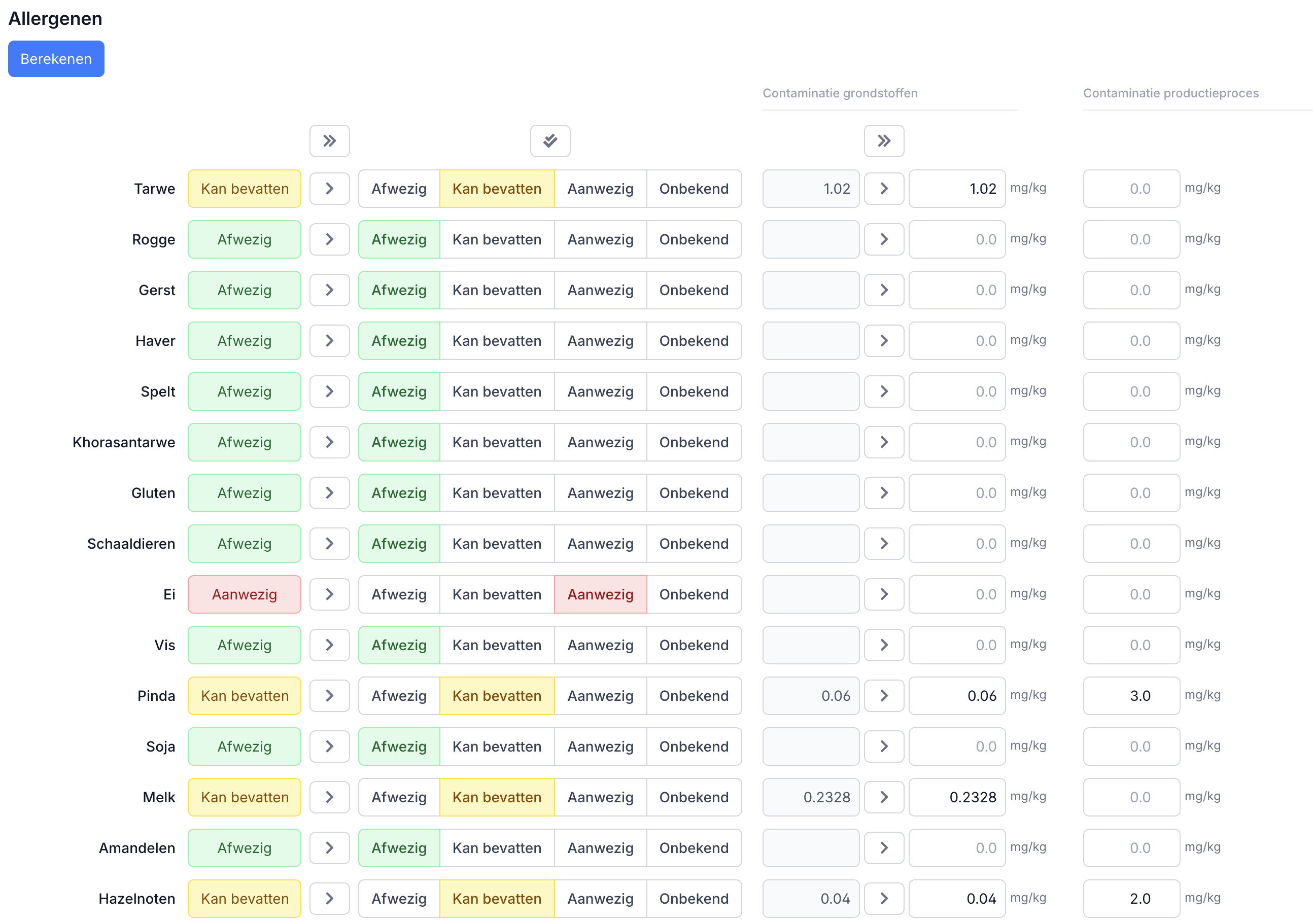
- Allergen information: overview of allergens present, potential cross-contamination and precautionary allergen labelling (PAL)
- Nutritional values: full nutrition declaration per 100 grams and per portion
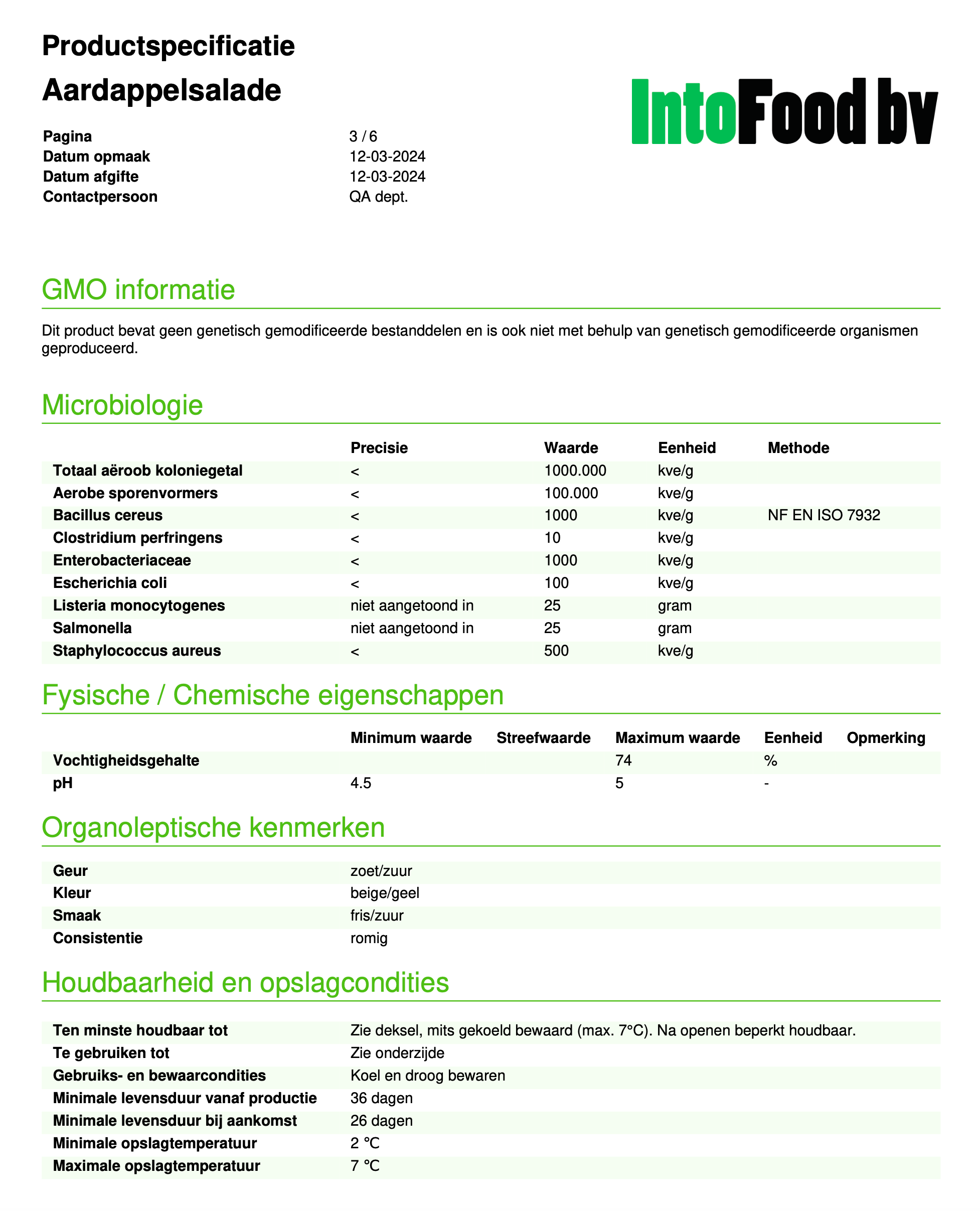
- Microbiological specifications: limits for pathogens (Salmonella, Listeria, E. coli) and indicators (total viable count, Enterobacteriaceae, yeasts, moulds)
- Physicochemical parameters: pH value, water activity, fat content, salt content
- Organoleptic properties: taste, smell, colour and texture
- Shelf life and storage conditions: best-before date, storage temperature and storage instructions
- Packaging specifications: consumer packaging, trade packaging and pallet configuration with dimensions and weights
- Preparation methods: instructions for preparation or processing
- Certifications and quality marks: FSSC 22000, BRCGS, IFS, organic, halal, kosher
- Regulatory information: CN codes for customs classification, country of origin and identification marks
That is a lot of information. And it all needs to be correct, up to date and consistently reflected on your label. That is exactly where many companies run into problems.
Why Are Product Specifications Essential?
Meeting Legal Requirements
Keeping correct product specifications is not optional - it is a legal obligation. EU Regulation 1169/2011 prescribes what information must appear on the label. That information originates from the product specification. The Food Standards Agency and other national authorities actively verify that labels match the actual product composition.
One of the most common causes of recalls: an ingredient changes, but the label is not updated. Centralised specification management prevents this because changes to recipes automatically flow through to all derived documents.
Ensuring Food Safety
Product specifications are intrinsically linked to your HACCP system. The microbiological limits, storage temperatures and allergen profiles in the specification directly relate to the critical control points in your food safety plan.
Building Trust in the Supply Chain
Buyers increasingly demand up-to-date and complete product specifications. A professional specification dossier strengthens your position as a supplier and accelerates the listing process with new customers. Those who can quickly deliver a well-structured product sheet have a competitive advantage.
Efficiency and Time Savings
Companies that manually manage specifications in spreadsheets spend an unnecessary amount of time updating, checking and sending documents. Every product change means manually searching which files need to be adjusted. Centralised management puts an end to that.
What Is Specification Management?
A supplier changes a raw material. A colleague adjusts the recipe. Regulations change. Each time you need to figure out which specifications are affected, update them, send the correct version to the right buyer and archive the old document.
Specification management means structuring that process rather than handling it ad hoc:
- All product information in one place
- Automatic flagging of what needs updating after changes
- Version control with complete change history
- Generating product specifications for buyers and internal use
- Collecting and validating raw material information from suppliers
The core principle: you shift from reactive ("the label is no longer correct") to proactive ("every change flows through automatically").
7 Steps to Professional Specification Management
This does not need to be a project lasting months. You can lay the foundation in a week. Then build out gradually.
Step 1: Take Stock of Your Current Situation
First step is the reality check: where do your specifications actually live? For most companies the answer is: everywhere and nowhere. Excel files, email attachments, a folder in the ERP, paper dossiers in a cabinet. Map out per product what you have and how current it is. Chances are you will find gaps.
Step 2: Define the Structure
One template, all products. Determine which data you capture per product: recipe, ingredient declaration, allergens, nutritional values, microbiological specifications, shelf life, storage conditions and packaging information. The same structure for every product prevents you from constantly searching for where specific information lives.
Step 3: Centralise in One System
This is the step where many companies get stuck. The temptation is to force specification management into the existing ERP, but ERP systems are rarely built for the food industry. A dedicated tool like Eclarion connects directly to what you need: recipe management, allergen management, nutritional value calculation and generating product specifications. You are operational within a day.
Step 4: Verify and Validate
Go through each product to check whether the recorded information is correct and complete. Is the recipe accurate? Are the nutritional values current? Validate raw material information together with suppliers. Allergens deserve extra attention: check per raw material the status ("free from", "may contain" or "contains") and determine whether precautionary allergen labelling (PAL) is needed. Eclarion can calculate this automatically via the PAL assessment.
Step 5: Set Up Version Control and Audit Trail
Record every change: who, what, when. An auditor does not want to hear that "someone changed something last year". In Eclarion, version control is maintained automatically. Previous versions are immediately retrievable and restorable.
Step 6: Establish Workflows for Change Management
Who is allowed to change what? And who approves it? Without clear roles, a production employee can modify a recipe that silently flows through to the label. Define permissions and approval workflows before that happens.
Step 7: Evaluate and Improve Continuously
Regulations change, buyers set new requirements, your range grows. Schedule at least an annual review of your specification management. What worked last year for twenty products does not necessarily work for fifty.
Common Challenges in Specification Management
Outdated Specifications
A supplier quietly replaces sunflower seed oil with rapeseed oil in a raw material. The specification is not updated. The label still mentions sunflower seed oil. During a food authority inspection or an allergic reaction from a consumer, you have a problem that could have been prevented.
Fragmented Storage
The QA manager has version 3 in her mailbox, production works with version 1 from the ERP, and the buyer received version 2 as a PDF last month. Sound familiar? As long as specifications are scattered across systems, spreadsheets and mailboxes, it is impossible to guarantee that everyone is working with the same version.
Manual Calculations
One misplaced decimal in an Excel formula can cascade through dozens of product specifications. Manually calculating nutritional values, compiling ingredient declarations or determining the allergen profile is error-prone and time-consuming. Software that does this automatically based on the recipe saves not only time but structurally prevents errors.
Collaboration with Suppliers
Collecting up-to-date raw material information from suppliers is an endless process of emailing, calling back and emailing again for many companies. Data pool platforms and integration standards make it possible to import raw material information directly into your specification system.
How Software Contributes to Better Specification Management
With ten products you can manage in Excel. With a hundred, you cannot. The number of parameters grows with your range: more products, more raw materials, more allergens, more buyers each with their own information requirements. At some point the question is not if something goes wrong, but when.
Automatic Calculations
Change a raw material in the recipe, and all derived values are recalculated instantly: nutritional values, allergen profile, ingredient declaration. No spreadsheet to manually check.
Generating Product Specifications
One click, and you have a professional product specification as a PDF. Different templates for different purposes: a product sheet for buyers, a production sheet for the shop floor, a detailed specification for audits. In Eclarion you assemble these layouts yourself.
Label Generation
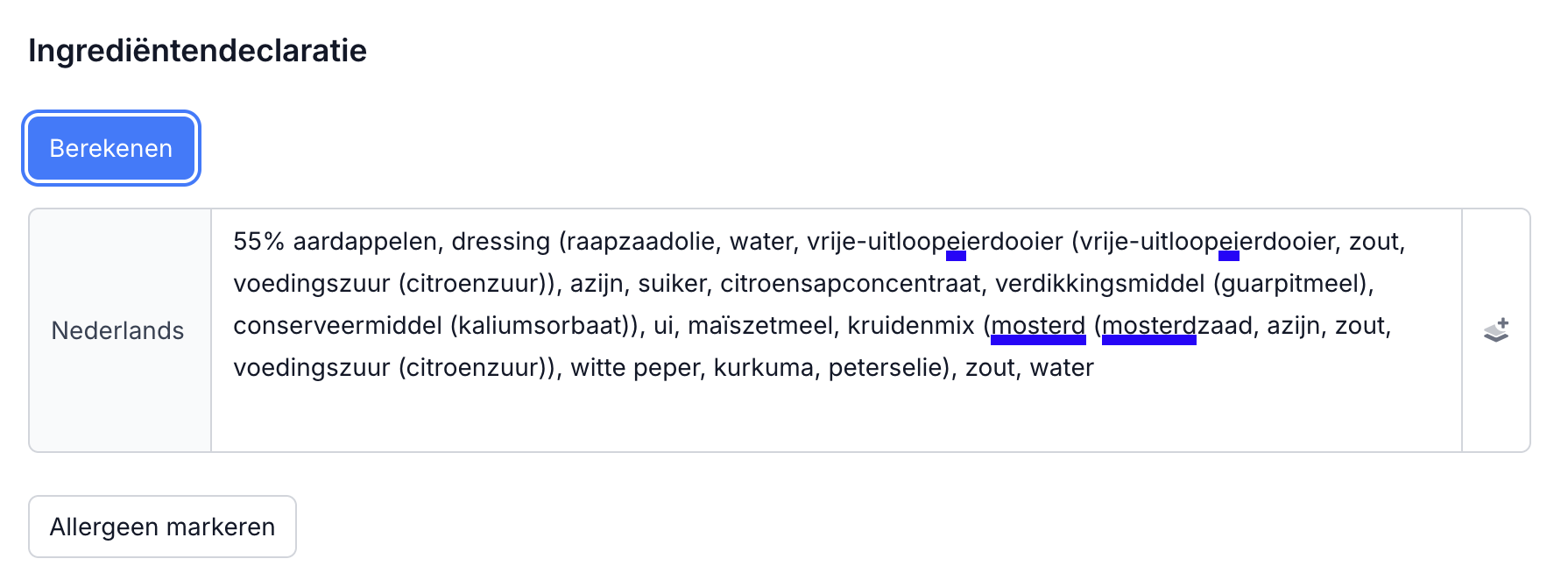
The step from specification to label is where many errors occur. When the ingredient declaration and allergen labelling are automatically generated from the specification, you eliminate discrepancies.
Full Audit Trail
Auditor visiting? Every change is logged with date, time and user. Previous versions are immediately retrievable and restorable. That makes you audit-ready for FSSC 22000, BRCGS and IFS, and meets the documentation requirements of HACCP principle 7.
Integrations with Existing Systems
Specification software that connects to ERP systems, data pools and standards such as GS1 prevents double entry and keeps everything synchronised.
Why Not an ERP Module for Specification Management?
Many food manufacturers consider housing specification management in their existing ERP system. Understandable: it is already there, and the vendor probably offers a module. But in practice this creates problems.
ERP systems are built for finance, procurement and logistics. The specification modules offered alongside them are typically generic: they work with free text fields instead of structured food data. Additionally, implementing an ERP module is rarely straightforward. It involves customisation, often an external consultancy firm, and a lead time that quickly runs into years.
| Excel / Word | ERP module | Dedicated tool | |
|---|---|---|---|
| Nutritional value calculation | Manual | Limited or none | Automatic from recipe |
| Allergen management | Manual | Free text fields | Structured with cross-contamination |
| Generating product specifications | Manual formatting | Limited templates | Flexible layouts, one click |
| Ingredient declaration | Manual compilation | Manual | Automatic per EU 1169/2011 |
| Version control and audit trail | None | Basic | Full with restore |
| Implementation time | Immediate | Years | Days |
That does not mean your ERP is redundant. On the contrary: the best approach is a dedicated tool for specification management that seamlessly integrates with your ERP for the data that belongs there (item numbers, prices, stock levels). That way you use each system for what it does best.
Frequently Asked Questions About Product Specifications
What are the key legal requirements for product specifications?
EU Regulation 1169/2011 is the core legislation for food labelling in the EU. This regulation prescribes that fourteen allergens must be declared, that a nutrition declaration must appear on the label, and that the ingredient declaration must be presented in descending order of weight. In addition, sector-specific requirements apply and the Food Standards Agency and equivalent authorities actively monitor compliance.
How often should specifications be updated?
Specifications should be updated with every change in the recipe, a change in raw material supplier, altered production conditions or new regulations. Additionally, a periodic review (at least annually) is good practice. This is also emphasised in HACCP guidelines and certification standards such as BRCGS Food Safety.
What is the difference between a product specification and a product sheet?
In practice, the terms are used interchangeably. Strictly speaking, the product specification is the complete dossier with all detailed information about a product. A product sheet is a derivative: a selection of specification data, presented in a professional format that you share with buyers. In Eclarion you generate product sheets directly from the product specification.
Can I manage product specifications in Excel?
For a handful of products you can get away with Excel. But it does not scale. Excel offers no automatic calculation of nutritional values, no allergen management with cross-contamination analysis, no version control and no audit trail. As soon as your range grows or a buyer requests a professional product sheet, you hit a wall.
How do I choose the right software for specification management?
Choose software specifically designed for the food industry. Generic document management systems and ERP modules lack the structured food data you need. Essential functionality: recipe management with automatic nutritional value calculation, allergen management, generating product specifications, audit trail and integration capabilities with your ERP and data pools. Read more about choosing between dedicated and generic solutions in our article on PLM software for the food industry.
What is the difference between specification management and PLM?
Specification management focuses on recording and keeping product information up to date. PLM (Product Lifecycle Management) is a broader concept covering the entire product lifecycle, from concept and development to production, distribution and phase-out. Specification management is a component of PLM.
The Question Is Not If, But How
Product specifications are the backbone of quality management in the food industry. They connect recipe management, labelling, food safety and compliance in one central document. You have roughly three options: muddling through in Excel (until something goes wrong), having an expensive ERP module implemented (with consultants and years of lead time), or choosing a dedicated tool that has you operational within a day.
With Eclarion you manage recipes, allergens, nutritional values, microbiological parameters and certifications centrally. With automatic calculations, flexible product specifications and a full audit trail. No years-long implementation project, no consultants, just start. Start with a free trial or read more about the benefits of Eclarion.