New EU rules for the identification mark (oval)
Since 9 May 2024, new rules apply to the identification mark (the 'oval') on food of animal origin. Delegated Regulation (EU) 2024/1141 requires the designation "European Community" (EC) to be replaced by "European Union" (EU).
At a glance: EU identification mark change
What is changing? From 9 May 2024, you must replace "EC" with "EU" on the identification mark (oval) of animal products. Old marks may be used until 31 December 2028, but switch over in good time.
What do you need to do? Update your identification mark via Account > Your account in Eclarion. Choose EU, EC or UE as the new abbreviation.
Why does this matter? EU Regulation 2024/1141 makes this mandatory for traceability and food safety. Non-compliance means products cannot be sold after 2028.
The identification mark is a mandatory element on food of animal origin produced in approved establishments. Its purpose is to ensure traceability, food safety and the origin of products.
How is the identification mark structured and what is changing?
The identification mark remains an oval containing:
- Country: The mark must show the name of the country where the establishment is located, either written in full or indicated with a two-letter code according to the relevant ISO standard. Eclarion uses the abbreviations for the various member states: AT, BE, DE, DK, ES, FI, FR, GR, IE, IT, LU, NL, PT, SE and UK.
- Approval number: The unique number assigned to the establishment by the competent authority.
- European Union designation: This has fundamentally changed. Instead of the old "European Community" (EC) abbreviations, one of the following "European Union" (EU) abbreviations must now be used:
- EC – European Community (English)
- EU – European Union (multiple languages)
- EL – Ευρωπαϊκή Ένωση (Greek)
- UE – Union Européenne (French) / Unión Europea (Spanish) / Unione Europea (Italian) / União Europeia (Portuguese)
- EE – Euroopa Liit (Estonian)
- AE – An tAontas Eorpach (Irish)
- ES – Europos Sąjunga (Lithuanian)
- EÚ – Európska únia (Slovak)
Note: These are the new EU abbreviations replacing the old EC ones. For the UK market, EC is most commonly used. The choice of abbreviation may depend on the market where the product is sold (and the language commonly used there), or customer preference. The important thing is to remain consistent within your own business.
How do you set this up in Eclarion?
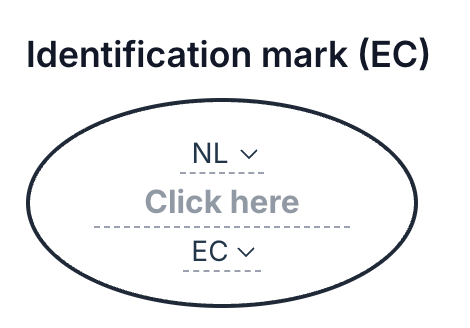
In Eclarion you can easily update the identification mark to comply with the new legislation. Follow these steps:
- Go to settings: Navigate to Account > Your account.
- Select the correct country
- Enter the correct identification number: by clicking "click here"
- Choose the correct abbreviation: Select the desired EU abbreviation (e.g. EC, EU, UE) from the list of official EU language abbreviations.
- Review and confirm: Check the changes and click Save.
All product specifications are now updated automatically.
What is the transition period for the new identification mark?
Until 31 December 2028, products with the old "European Community" mark (such as "EC" for the UK, "CE" for France, "EF" for Denmark) may still be sold, provided they were produced before this date. From 31 December 2028, all products must use the new EU abbreviations. Our advice: switch now to avoid the hassle of maintaining two label versions.
When is establishment approval required?
Businesses that process food of animal origin for human consumption generally need to be approved. An exception exists for businesses that primarily supply end consumers and only supply other businesses on a limited, local and incidental basis. Slaughterhouses and cold stores must always be approved.
Whether approval is required depends on the scale, location and nature of the activities. For example, a butcher with a shop who supplies a few local restaurants usually does not need approval, while a wholesaler who processes meat for wide distribution does. Products from non-approved establishments may never be supplied to approved establishments.
These guidelines safeguard food safety and animal welfare. If you are unsure whether your business needs approval or registration, the competent authority in your country can provide guidance with practical examples for food producers.
Frequently asked questions
Do I need to relabel my existing stock?
No. Products produced before 31 December 2028 with the old EC mark may be sold until the stock is depleted. New production runs must use the new EU designation.
Which abbreviation should I choose?
You can choose from: EU, EC, UE, EL, EE, AE, ES or EÚ. For the English-speaking market, EC or EU is most common. Exporting to France, Spain or Italy? Then UE may be more practical. The key is to remain consistent within your business.
Does this change apply to all food products?
No, only to food of animal origin (meat, fish, dairy, eggs) produced in approved establishments. Plant-based products do not require an identification mark.
What happens if I miss the 31 December 2028 deadline?
After this date, products with the old EC designation may no longer be placed on the market. Make sure you switch to the new EU abbreviation well before the deadline.
Where can I find the official legislation?
The full text is available in Delegated Regulation (EU) 2024/1141 on EUR-Lex.