Sulphites in Food: the Overlooked Allergen on the Label
Sulphites (E220–E228) are one of the 14 mandatory allergens that must be declared on the label under EU Regulation 1169/2011. Yet they are regularly missed — not intentionally, but because sulphites hide in ingredients where you least expect them.
What Are Sulphites?
Sulphites are sulphur-based compounds that occur naturally in foods and are widely added as preservatives and antioxidants. On the label you recognise them by E-numbers E220 through E228:
- E220 — Sulphur dioxide (SO₂)
- E221 — Sodium sulphite
- E222 — Sodium hydrogen sulphite
- E223 — Sodium metabisulphite
- E224 — Potassium metabisulphite
- E225 — Potassium sulphite
- E226 — Calcium sulphite
- E227 — Calcium hydrogen sulphite
- E228 — Potassium hydrogen sulphite
The legal name on the label is "sulphur dioxide and sulphites". In practice this is often shortened to "sulphites" or "SO₂".
Which Foods Contain Sulphites?
Sulphites appear in more products than you might think. Beyond the obvious sources (wine, dried fruit) there are many hidden sources that regularly catch QA managers off guard:
Well-known sources:
- Wine and beer (as preservative)
- Dried fruit (apricots, raisins, prunes)
- Mustard and horseradish
- Lemon juice (concentrated)
Hidden sources — often missed:
- Potato products — chips, potato flakes, mashed potato powder often contain sulphite as an antioxidant
- Prawns and crustaceans — sulphite is used to prevent blackening
- Wine vinegar and balsamic — obvious by itself, but overlooked as an ingredient in dressings and marinades
- Gelatine — certain types contain sulphite from the production process
- Glucose-fructose syrup — depending on the manufacturing process
- Sauces and stock cubes — via compound ingredients that contain sulphite
- Fruit juices — particularly concentrates
The tricky part: sulphites often enter via compound ingredients. A dressing contains wine vinegar, the wine vinegar contains sulphite. If you only enter the dressing as an ingredient without knowing the underlying composition, the sulphite is missed.
When Must Sulphites Appear on the Label?
The threshold for sulphites is 10 mg/kg or 10 mg/litre in the final product, expressed as SO₂. Above this limit, declaration is mandatory.
Important: this threshold applies to the total sulphite content in the final product, not per individual ingredient. If three ingredients each contribute a small amount of sulphite, the total can still exceed 10 mg/kg.
The declaration must appear in the ingredient list and must be visually highlighted, for example: "water, sugar, potato flakes, salt, sulphites".
Sulphites and the 10 mg/kg Threshold
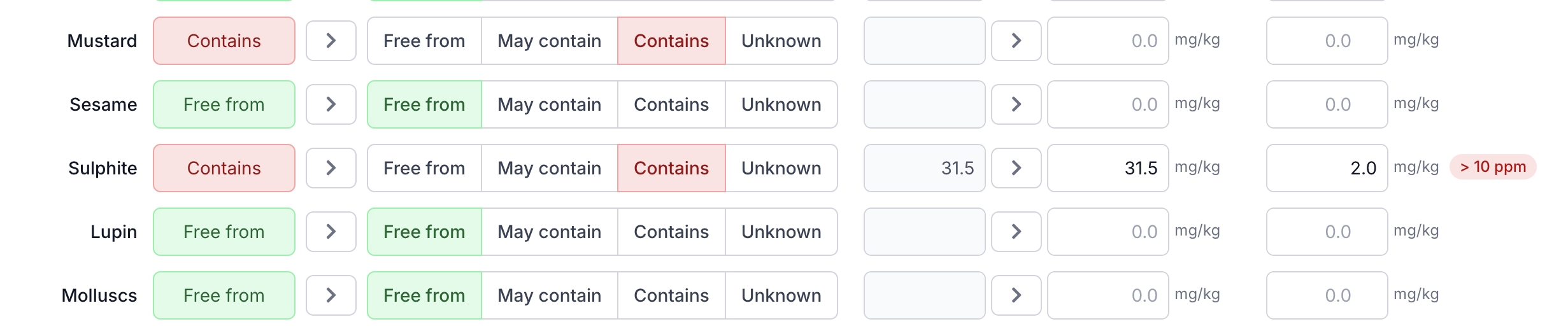
Unlike most allergens, sulphites are not subject to a quantitative risk assessment via the VITAL framework. Sulphites fall outside the PAL assessment used for the other 13 allergens. Instead, sulphites have a fixed legal threshold: 10 mg/kg SO₂ in the final product.
Eclarion offers a dedicated sulphite content calculation: you record the SO₂ concentration per ingredient, and the system automatically calculates the total in the final product. Does the total exceed 10 mg/kg? Eclarion shows this immediately with a red badge.
For cross-contamination via shared production lines (for example a line that also processes wine or mustard), the sulphite risk falls under your HACCP plan, not the PAL system.
Common Mistakes With Sulphites
Compound ingredients not broken down
The most common mistake. A dressing, marinade or stock contains sulphite via a sub-ingredient (wine vinegar, mustard), but the QA manager has only entered the main ingredient without the underlying composition. The sulphite is missed.
Sulphite below 10 mg/kg not documented
Many companies only document sulphite when it exceeds the threshold. But for a complete specification you need to know that sulphite is absent too. During an audit you must be able to demonstrate that you checked, not that you ignored it.
Supplier data not verified
Sulphite is not always explicitly stated on supplier specifications. Ask actively, especially for potato products, dried fruit, crustaceans and products containing wine or vinegar.
"Contains sulphites" as a safety net
Some companies put "contains sulphites" on the label as a catch-all. This is not permitted if there is no demonstrable source. Allergen declaration must be based on actual presence above the 10 mg/kg threshold, not caution.
Managing Sulphites in Practice
The key is completeness in your ingredient data. For each ingredient you must record:
- Does it contain sulphite as an additive? Check E-numbers E220–E228 on the supplier specification
- Is it a compound ingredient? Break down the composition and check each sub-ingredient
- What is the sulphite content? Record the mg/kg SO₂ for threshold calculation
- Is cross-contamination possible? Document this in your HACCP plan (sulphites fall outside the PAL system)

In Eclarion you record this on the allergen tab of each ingredient. When you build a recipe, the system automatically calculates total sulphite content from the bill of materials and instantly shows whether the 10 mg/kg threshold is exceeded. Supplier changes a raw material composition? Every recipe using that ingredient is recalculated automatically. Learn how to set this up step by step in Eclarion.
Frequently Asked Questions
Is sulphite allergy the same as a true allergy?
Strictly speaking, sulphite sensitivity is not an IgE-mediated allergy but an intolerance. However, it can cause severe reactions, particularly in asthma patients. The EU therefore classifies sulphites as a mandatory declarable allergen.
Must sulphites always appear on the label, even at very low levels?
Only if the total sulphite content in the final product exceeds 10 mg/kg (or 10 mg/l). Below that, declaration is not mandatory. But always document that you have verified it.
How do I calculate the total sulphite content of my product?
Add up the sulphite contribution from each ingredient, weighted by its percentage in the recipe. Example: if an ingredient contains 50 mg/kg SO₂ and makes up 5% of your recipe, the contribution is 50 × 0.05 = 2.5 mg/kg. Add all contributions for the total. In Eclarion this is calculated automatically from the bill of materials.
Does wine always exceed the sulphite threshold?
Yes, almost always. Most wines contain 50–200 mg/l SO₂. When wine is an ingredient in your product (sauces, marinades), you must include the sulphite content in the calculation.
What if my supplier does not provide sulphite data?
Ask explicitly. Sulphite is not always stated by default on supplier specifications, especially for potato products and concentrates. If the supplier cannot confirm, include the product in your risk analysis.