What Is PLM? Product Lifecycle Management in the Food Industry
PLM is short for Product Lifecycle Management: the structured management of all product information throughout the entire product lifecycle, from initial concept to phase-out. A PLM system provides a single source of truth for all product data. No loose spreadsheets, no emails with "spec_final_v3_FINAL.xlsx", no QA manager manually checking whether the specification still matches after a recipe change.
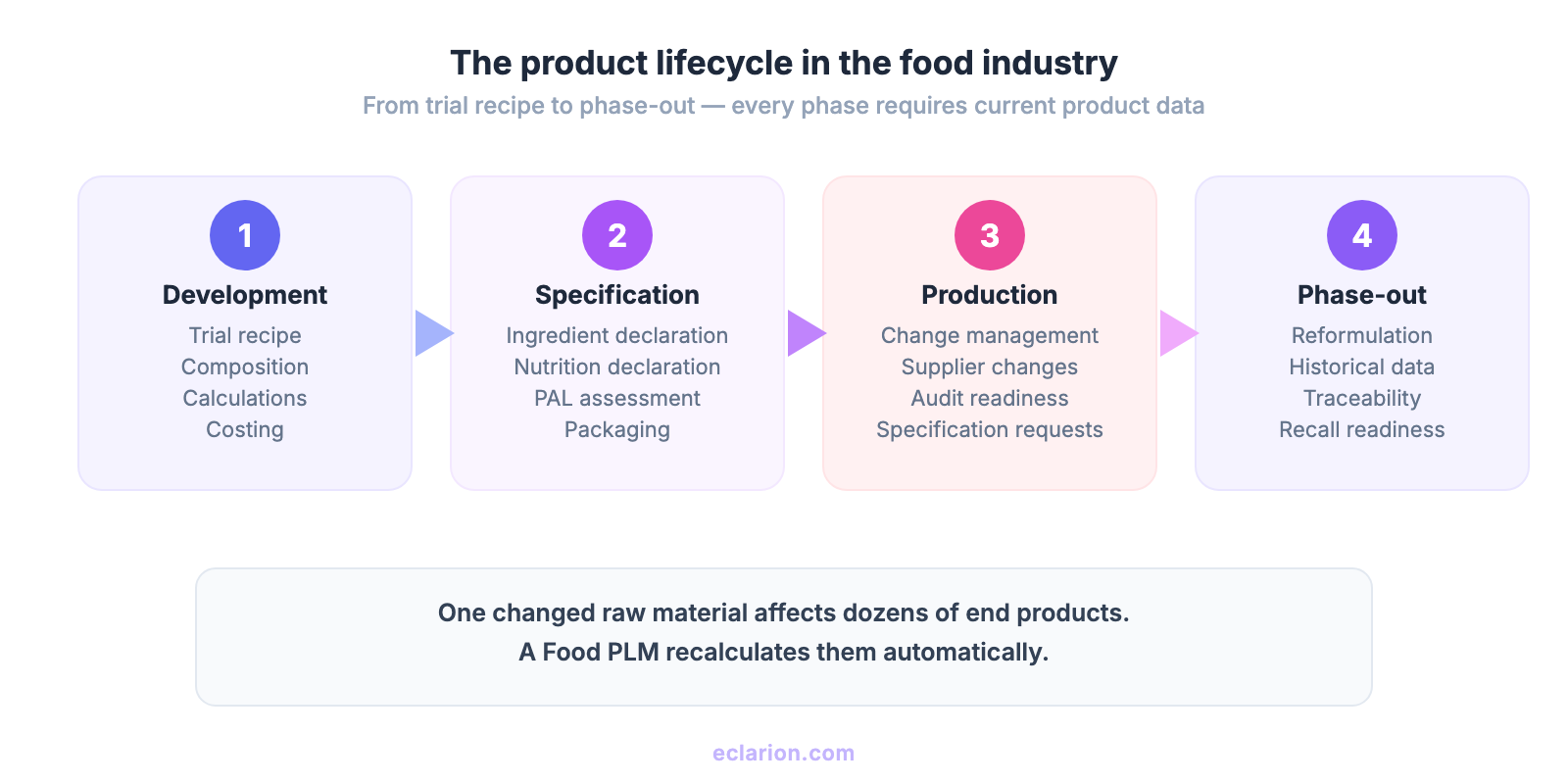
The product lifecycle of a food product
Development
R&D starts with a trial recipe: which ingredients, in what proportions, with what production process? During development the composition changes regularly, and with every change nutritional values, allergens and the ingredient declaration need to be recalculated.
Specification and compliance
Once the recipe is finalised, the product is fully specified: labelling in accordance with EU Regulation 1169/2011, PAL assessment for cross-contamination, packaging, logistics data.
Production and maintenance
The product goes into production, but the specification is not static. A supplier changes the composition of a raw material. The food safety authority publishes new rules. One changed raw material can affect dozens of end products. Who keeps track of which specifications need updating? In practice: nobody, until it goes wrong during an audit.
Phase-out
Products are modified (reformulation, cost optimisation, clean label) or phased out. The historical specification must remain available — if a recall comes on an ingredient two years from now, you need to trace which products contained that ingredient and what the label said at the time.
Why generic PLM software does not work for food
Traditional PLM software is built for manufacturing. A car has a bill of materials with part numbers. A food product has a recipe with percentages, allergens that need to be calculated through the entire chain, and nutritional values that change as soon as you switch flour supplier.
Generic PLM tools can manage a bill of materials, but not build an ingredient declaration with the correct hierarchy, QUID percentages and allergen highlighting. They have no weighted nutritional value calculation, no 14 mandatory EU allergens, no rounding rules. The result: food companies that implement a generic PLM end up building spreadsheets alongside it for the calculations the PLM cannot do.
PLM vs ERP
PLM and ERP are regularly confused, but they do fundamentally different things:
| System | Core function | Example |
|---|---|---|
| ERP | Operational processes: procurement, inventory, finance, logistics | SAP, Microsoft Dynamics, Oracle |
| PLM | Product lifecycle: document management, change processes, project management | ERP modules, broad PLM packages |
The ERP knows how much of a product is in stock. A PLM manages the product data and change process. In the food industry a third category is needed: a system that knows what is in the product, what must go on the label and whether it complies with regulations. That is what we call Food PLM. Through an API integration these systems work together.
What a Food PLM does differently
A specialised Food PLM like Eclarion combines lifecycle management with the calculations and compliance the food industry requires:
- Recipe management with nested bills of materials and compound ingredients
- Automatic calculations of nutritional values, allergens and the ingredient declaration — change a raw material and every recipe using it is automatically updated
- PAL assessment for cross-contamination risks per VITAL standard
- Audit trail — every change is logged (who, what, when), previous versions can always be retrieved
- Product specifications — multilingual and always current
- API integration with ERP, data pools (GS1) and other systems
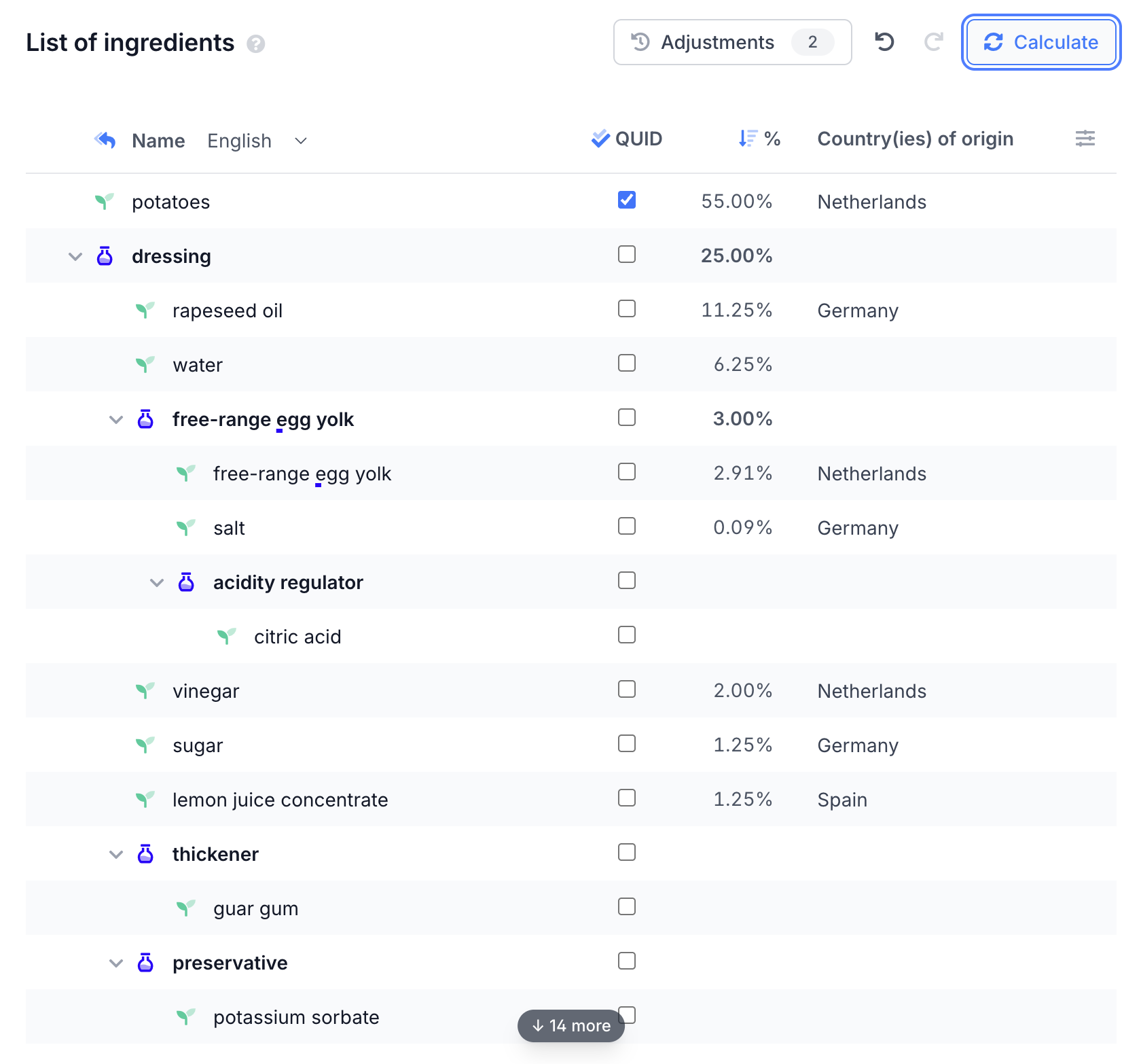
The difference with a generic PLM? You can start within days instead of months.
Choosing PLM software: ask these questions
Looking for PLM software for the food industry? These are the questions that separate the wheat from the chaff:
- Do you calculate from the bill of materials? Many systems record nutritional values and allergens but do not calculate them automatically from the recipe. That is the difference between storing data and making data work.
- What happens when a raw material changes? Are all recipes using that raw material automatically recalculated, or does someone need to update them manually?
- Do you know EU regulations? The 14 mandatory allergens, rounding rules for nutritional values, multilingual labelling — is that built in, or do you need to build it around the system?
- How quickly am I operational? Days or months? A PLM implementation that takes a year is already outdated by the time it goes live.
- Can I connect to my ERP? An open API is the difference between an integrated system and yet another silo.
From spreadsheets to Food PLM
Most food companies start with spreadsheets. Recipes in Excel, nutritional values manually copied from supplier specifications, allergen overviews in a separate file. That works with 10 products. With 50 products it becomes fragile. With 200 products it is unsustainable.
The switch to a Food PLM solves four problems every QA manager with spreadsheets recognises:
-
"A supplier changed something and I don't know which products are affected." In Excel you manually search which recipes use a raw material, recalculate nutritional values per product and update the declaration. In a Food PLM you update the raw material once and every recipe is automatically recalculated.
-
"I can't prove who changed what and when." An auditor asks for the specification of a product as it looked last year. In Excel you dig through folders and mailboxes. In a Food PLM you open the version history and see exactly who changed what.
-
"Anyone can edit the spreadsheet." A production worker opens the file and accidentally changes a recipe. Nobody notices until the next audit. In a Food PLM you control who can view, edit or approve.
-
"We have three versions and nobody knows which one is current." The specification is in a spreadsheet, the supplier data in an email, the allergen status in yet another file. In a Food PLM there is one source: change something and it is updated everywhere.
Frequently Asked Questions
What does PLM mean?
PLM stands for Product Lifecycle Management. It means centrally managing all product information throughout the entire lifecycle. In the food industry that covers recipes, allergens, nutritional values, labelling and compliance.
Is PLM the same as ERP?
No. ERP manages operational processes (procurement, inventory, logistics). PLM manages product data (recipes, specifications, compliance). Most food companies need both, connected via an API.
Do we need PLM as a small company?
If you have more than a handful of products and deal with allergen declarations, nutritional values and changing suppliers, then yes. Company size is not the deciding factor — the complexity of your product data is.
What does a PLM implementation cost?
Generic PLM systems take months of implementation and configuration. A specialised Food PLM like Eclarion is operational within days because it is already set up for the food industry.
Can PLM software replace our existing systems?
A Food PLM does not replace your ERP but complements it. It takes over the product data part that your ERP cannot handle well: recipe calculations, allergen management, labelling and compliance.
Eclarion is built for exactly this: recipe management with automatic calculations, generating product specifications and full compliance with EU regulations. See all features or start a free trial.